
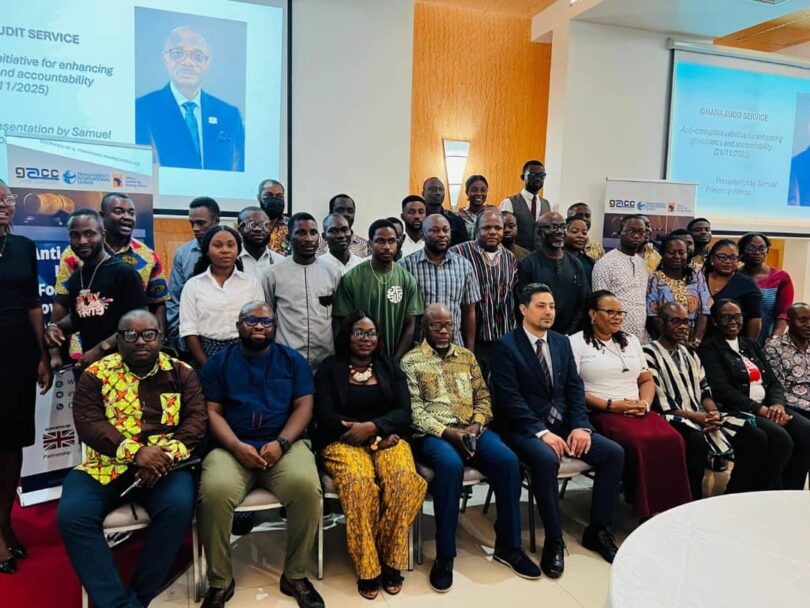

The Ghana Anti‑Corruption Coalition (GACC), in partnership with the Africa Centre for Energy Policy (ACEP), the Ghana Integrity Initiative (GII), the Ghana Audit Service, and the UK’s Foreign, Commonwealth & Development Office (FCDO), has concluded an intensive capacity‑building workshop aimed at sharpening journalists’ skills in analysing Auditor‑General’s Reports and effectively using the CitizensEye App for evidence‑based anti‑corruption reporting.
The workshop is part of ACEP’s project “An Anti‑Corruption Initiative for Enhancing Governance and Accountability,” funded by FCDO.
GACC’s Executive Secretary, Mrs. Beauty Emefa Narteh, explained that the training was designed to strengthen journalists’ grasp of the Auditor‑General’s mandate under Article 187 of the 1992 Constitution, improve their ability to interpret audit findings, and familiarise them with digital tools such as the CitizensEye App that aid investigative journalism. “We expect participants to share the knowledge gained with their colleagues so the impact is multiplied beyond this room,” she added, underscoring the media’s vital role in scrutinising audit outcomes and monitoring corrective actions taken by state institutions.
The Executive Director of the Ghana Integrity Initiative, Mrs. Mary Addah, described the training as timely and innovative. “We engage with the media daily, and the accuracy of reporting is critical to this fight,” she said, urging journalists to understand audit processes and leverage tools like CitizensEye to promote transparency.
The Policy Lead for Petroleum and Conventional Energy at ACEP, Mr. Kodzo Yaotse, said the session was meant to help journalists appreciate the work of the Ghana Audit Service and support efforts to recover losses arising from audit infractions. He encouraged reporters to build their capacity to interrogate audit findings and educate the public.
The Head of Political and Governance at FCDO, Mr. Hooman Nouruzi, praised the partner institutions for equipping the media with skills to explain complex audit issues to the public. “Your reporting ensures citizens are informed, institutions are held accountable, and public trust is maintained,” he stated, noting that while audit reports are powerful accountability tools, their technical nature often limits their use, making the media’s role indispensable.
Assistant Director of Audit and Information Officer at the Ghana Audit Service, Mr. Frederick Lokko, cautioned journalists to report cash irregularities with accuracy and context.
“An irregularity is something done contrary to law, but not every cash irregularity amounts to misappropriation,” he explained, urging reporters to read full audit reports—including recommendations—to distinguish between documentation lapses, procedural breaches, negligence, and potential misappropriation.
He clarified that the Auditor‑General lacks prosecutorial powers; enforcement rests with EOCO and the Attorney‑General’s Department.
Deputy Auditor‑General Mr. Lawrence Ayagiba said the programme was timely, especially as the Service works to improve public understanding of audit outcomes. “Our reports are written for Ghanaians, but the language can be technical. Many people do not even realise when the reports concern their own districts,” he noted, emphasizing that journalists are essential in breaking down the reports for citizens.
Assistant Auditor‑Generals *Samuel Frimpong‑Manso and Thomas Nunoo outlined the rigorous standards and quality control procedures guiding public sector auditing. They walked participants through the full audit cycle—planning, execution, fieldwork, reporting—and explained the significance of opinions, management letters, and escalated findings.
Director of Audits Madam Roberta Ntim and other senior officers demonstrated how the CitizensEye App allows citizens to report suspected fraud, mismanagement, waste, and poor service delivery. Backed by *Section 51 of the Audit Service Regulations, 2011 (C.I. 70)*, the app helps the Audit Service detect red flags and prioritise emerging issues. She encouraged journalists to promote and use the app as part of efforts to strengthen public accountability.
The workshop brought together journalists, civil society representatives, officials of the Ghana Audit Service, and the British High Commission, all reaffirming their commitment to advancing transparency, accountability, and good governance in Ghana.
Report By: Ishmael Barfi
Source: www.thenewindependentonline.com