


Report By: Ishmael Barfi
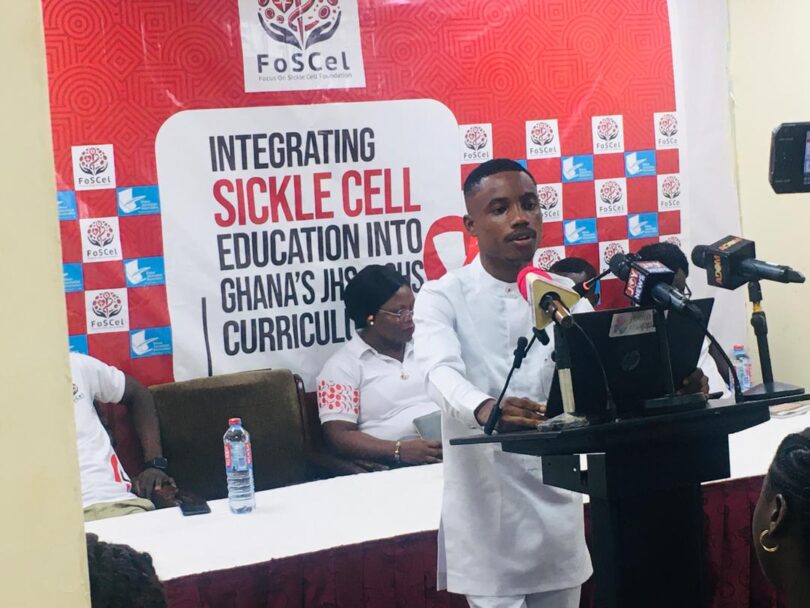
Accra, Ghana – The Focus on Sickle Cell Foundation (FoSCel) has made a passionate plea to the government to incorporate Sickle Cell education into the country’s junior high school (JHS) and senior high school (SHS) curriculum. The call was made by Amos Andoh, Founder of FoSCel, who is also living with Sickle Cell Disease, at a stakeholders’ engagement in Accra.
According to FoSCel, about 18,000 babies are born with Sickle Cell Disease every year in Ghana, and many students complete school without understanding the disease. This lack of awareness leads to avoidable pain, stigma, and complications for those living with the condition. The Foundation believes that early education is key to preventing these issues and promoting informed health decisions.
“We are not just talking about statistics, we are talking about children, families, and futures,” Amos Andoh emphasized. “Knowledge protects life, and early awareness changes destinies. That is why FoSCel exists – to educate, to advocate, and to support without silence.”
FoSCel has developed a comic strip education model to simplify Sickle Cell education and has piloted it in schools and communities with positive feedback. The model uses storytelling and illustrations to explain genotype inheritance, early screening, prevention, and stigma reduction. The Foundation is proposing that the model be scaled nationwide to support the implementation of the National Sickle Cell Disease Strategy.
The Minister of Health has been commended for launching the National Sickle Cell Disease Screening and Case Management Guidelines in December 2025. FoSCel believes that this initiative, combined with school-based education, will help reduce the burden of Sickle Cell Disease in Ghana.
“We envision a Ghana where students make informed health decisions, families are protected through genotype awareness, communities respond with empathy, and Sickle Cell warriors live with dignity,” Amos Andoh said. “We urge stakeholders to support the integration of Sickle Cell education into the school system, in partnership and alignment with national policy.”
The Foundation has already made significant strides in empowering communities through education, awareness, and screening. They have organised a National Symposium, conducted awareness sessions in schools and communities, and partnered with counsellors to prioritise genotype education in premarital counselling.
FoSCel is ready to contribute research, tools, and community experience to support the integration of Sickle Cell education into the school curriculum. “Together, we can ensure that Ghana’s Sickle Cell education moves from policy to practice,” Amos Andoh said.
Source: www.thenewindependentonline.com