

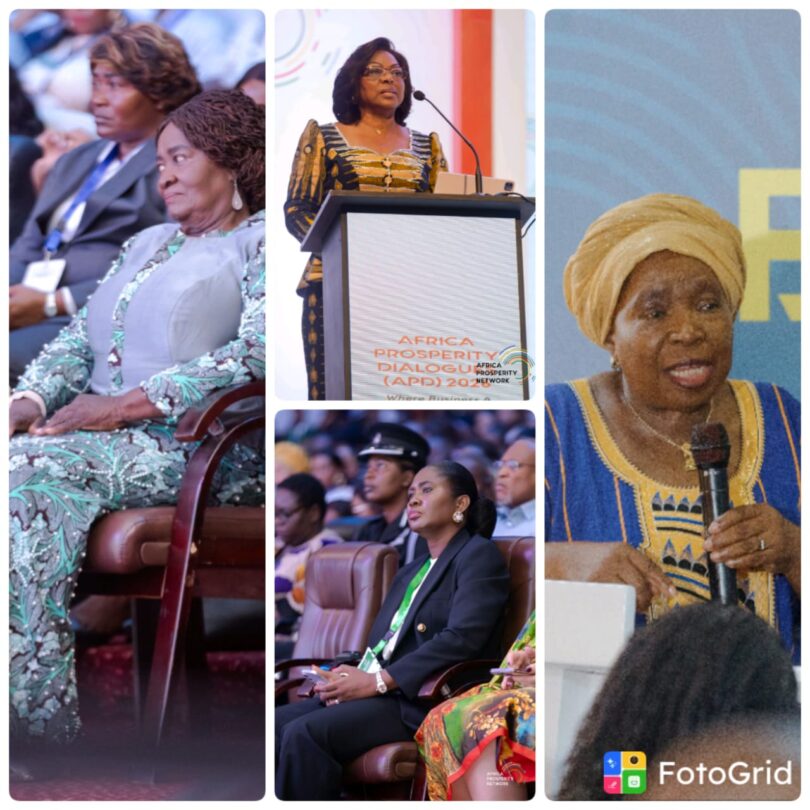

Report By: Ishmael Barfi
Women leaders from various sectors have emphasized the importance of women’s participation in advancing Africa’s economic integration under the African Continental Free Trade Area (AfCFTA) at the 2026 Africa Prosperity Dialogues (APD) in Accra, Ghana. The high-level panel discussion, themed “From Boardrooms to Borders: Women Driving the AfCFTA Agenda,” highlighted the critical role women play in shaping trade policy, influencing corporate strategy, and driving inclusive growth across the continent.
The discussion, held under the theme “From Boardrooms to Borders: Women Driving the AfCFTA Agenda,” at the Accra International Conference Centre (AICC) on Wednesday, 4th February 2026, brought together distinguished women leaders who shared insights on how women are shaping trade policy, influencing corporate strategy, and driving inclusive growth across the continent.
The panel featured Professor Nana Aba Appiah Amfo, Vice-Chancellor of the University of Ghana; Patricia Poku Diaby, Executive Chair of Plot Enterprises and Advisory Council Member of the Africa Prosperity Network (APN); Pearl Nkrumah, Managing Director of Access Bank Ghana; Nana Oye Bampoe Addo, Deputy Chief of Staff for Administration at the Office of the President of Ghana; and Professor Marie-Line Sephocle, Founder of the Women Ambassadors Foundation and the Women Ambassadors Conference.
Stronger Collaboration
Prof. Nana Aba Appiah Amfo, Vice-Chancellor of the University of Ghana, Legon, stressed that collaboration and partnerships are essential to preparing young people and women to take advantage of the opportunities offered under the African Continental Free Trade Area (AfCFTA).
Prof. Amfo said institutions cannot achieve meaningful development outcomes in isolation. She noted that the University of Ghana has placed engagement and partnerships at the heart of its strategic priorities.
“Our fourth strategic priority is engagement and partnerships because we recognize that whatever we want to achieve, we cannot do it on our own,” she stated.
Prof. Amfo explained that while universities are primarily responsible for training and research, their work becomes more impactful when carried out in partnership with industry and other institutions. She cited the University of Ghana’s recently launched innovation enclave and maker space as an example of successful collaboration, made possible through partnerships with both local and international organisations.
From Cocoa Price Takers to Value Negotiators
Patricia Poku Diaby, Executive Chair of Plot Enterprises and a member of the Africa Prosperity Network (APN) Advisory Council, called for stronger African cooperation and increased value addition in the cocoa sector. She stressed that the continent must move from being a price taker to becoming a value negotiator in the global cocoa market.
Madam Poku Diaby noted that West Africa remains the powerhouse of global cocoa production, with Ghana and Côte d’Ivoire alone accounting for over 60 percent of the world’s supply. When combined with other producers such as Nigeria and Cameroon, she said the region provides nearly 80 percent of cocoa that feeds the global chocolate industry.
Despite this dominance, she lamented that African producers continue to exert little influence over pricing and market decisions. “We feed the industry, but in spite of this dominance, we don’t influence anything—neither pricing nor even the market,” she said.
Madam Poku Diaby highlighted the economic and social importance of cocoa to Ghana and Côte d’Ivoire, describing it as the backbone of both economies. In Ghana, cocoa remains the second-largest foreign exchange earner and supports the livelihoods of about two million smallholder farmers. Globally, she added, more than 44 million families depend on cocoa-related income.
Seamless Payments to Boost Women-Led AfCFTA Trade
Pearl Nkrumah, Managing Director of Access Bank Ghana, called for stronger financial systems and seamless payment structures to support women-led trade under the African Continental Free Trade Area (AfCFTA). Accordingly, she emphasised that inclusive trade will only thrive if cross-border transactions are made easier and more efficient.
Madam Nkrumah noted that unlocking capital—both within and outside Africa—depends largely on whether countries create enabling environments that allow investments and financing to flow smoothly into local economies.
She explained that while Ghana and other African states are already pursuing blended financing arrangements and strategic partnerships with external partners, the real priority must be ensuring that financing directly supports productive trade activities, especially for women entrepreneurs operating across borders.
“For women trading among ourselves, the key question is how do we enable platforms that make it smooth and fluid for a woman in Ghana to ship products to other countries and receive payment back seamlessly,” she said.
Madam Nkrumah highlighted that women-owned businesses require not only access to capital but also functional trade ecosystems—marketplaces, procurement networks, and payment channels—that allow them to move from small enterprises into larger suppliers and regional trade partners.
Stronger AfCFTA Support for Women Traders
Nana Oye Bampoe Addo, Deputy Chief of Staff for Administration at the Office of the President of Ghana, called for strategic and well-resourced implementation of the African Continental Free Trade Area (AfCFTA) protocols to ensure women engaged in informal cross-border trade fully benefit from the agreement.
She noted that women account for nearly 70 percent of informal cross-border trade across the continent, making them indispensable to Africa’s trade and economic integration agenda.
Drawing from a personal experience during a visit to The Gambia in March last year, she recounted witnessing salted fish being purchased and packed into trucks for transport back to Mankessim in Ghana’s Central Region. “How does AfCFTA provide opportunities to expand that trade? How does it create an enabling environment for payments and smooth cross-border movement?” she asked, stressing the need for policies that reflect the realities of informal traders.
Nana Oye expressed concern about persistent trade barriers, including challenges in moving goods even between neighbouring countries such as Ghana and Côte d’Ivoire. She argued that such obstacles highlight the urgency for governments, particularly trade ministries, to work in synergy to make AfCFTA’s objectives achievable. “This means that whatever we do in implementing AfCFTA and the protocols must be strategic and deliberate,” she said.
African Diaspora Wealth
Prof. Marie-Line Sephocle, Founder of the Women Ambassadors Foundation and the Women Ambassadors Conference, highlighted the significant economic and educational potential of the African diaspora in the Americas. She urged Africa leaders to engage strategically with these communities to drive trade, investment, and development.
Prof. Sephocle emphasized that the African diaspora across the Americas, spanning 35 countries, represents not only a resilient population with a shared history but also a source of wealth, institutional knowledge, and networks that African countries can leverage.
“Within the United States alone, there are 30 thriving African American-owned banks and 105 African American universities,” she noted. “These institutions, alongside chambers of commerce and other organizations across countries like Colombia, represent untapped opportunities for partnerships and investment in Africa.”
Prof. Sephocle cited Howard University, an iconic African American institution, as an example of the educational and social capital embedded within the diaspora. She stressed that African nations must recognize and strategically connect with these institutions to harness their potential in advancing the continent’s economic agenda.
“Engaging the diaspora is not just about capital—it’s about knowledge, networks, and influence that can accelerate Africa’s trade and development objectives,” Prof. Sephocle said further.
Source: www.thenewindependentonline.com