By: Alhaji Seidu Agongo
Across the world, every nation’s path to sustainable economic transformation is anchored on one truth: lasting progress is possible only when the foundational pillars are strong, coherent and deliberately built.
Over the years, however, Ghana’s macroeconomic signals, governance structures and social cohesion have too often moved out of sync, creating a disjointed environment that limited the country’s ability to convert potential into sustained growth.
In most cases, our periods of stability were frequently undermined by institutional weaknesses or social pressures, while moments of reform struggled to gain full traction because the economic and social pillars required to support them were not aligned.Today, however, the country finds itself in a unique position. Key pillars of macroeconomic stability, institutional reform, and social progress are increasingly aligning.
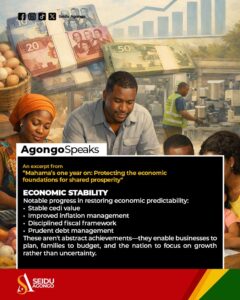
The groundwork for long term prosperity is becoming visible, and the task ahead is to protect these gains, deepen them, and channel their benefits into the daily lives of citizens and businesses.For many across the political divide, Ghana has made notable progress over the past year in restoring economic predictability — a critical ingredient for investor confidence and business planning.
Stability in the value of the cedi, improvements in inflation management, a more disciplined fiscal framework, and prudent debt management are not abstract achievements. These are the bedrock upon which every productive activity rests – from the operations of small market women to large-scale industrial ventures. When these indicators hold steady, those of us in the private sector can plan long-term, families can better predict their cost of living, and the nation as a whole can direct its energy towards growth rather than uncertainty.
Institutional reforms
Another important has been the effort to reinvigorate the governance and regulatory environment. Few things matter more for national development than institutions that are transparent, responsive, and insulated from abuse. That is why the recent constitutional, regulatory, and administrative reforms — particularly those aimed at improving accountability, strengthening oversight, and refining the management of natural resources — are steps in the right direction.
A clear example is the introduction of the commitment control rule under the amended Public Financial Management Act, which now requires explicit Ministry of Finance approval before any public contract becomes valid. This single reform has tightened fiscal discipline, curbed indiscriminate contract awards, and protected the state from the perennial build up of avoidable liabilities.
Similar efficiency driven reforms are reshaping key institutions. The Public Procurement Authority has upgraded its systems to reduce opaque sole sourcing; the Ghana Gold Board is enforcing stricter oversight of gold licensing and aggregation with enormous benefits as seen in the astronomical growth in gold mined by small-scale miners; COCOBOD has enhanced auditing and quality control protocols across the cocoa value chain; and the Electricity Company of Ghana has intensified revenue protection measures through metering and digital monitoring.

Foundation is half the task
Together, these interventions signal a shift toward stronger governance, cleaner processes and more accountable management of national resources. They demonstrate a clear intent to modernise governance and ensure that Ghana’s abundant natural wealth works for the people rather than the other way around.
This progress reflects deliberate leadership by President John Dramani Mahama, with senior officials being guided to pursue reforms that strengthen institutions and serve the broader national interest.
They reflect a more focused and experienced approach to governance, reinforcing expectations and the hope that his ‘second coming,’ will bring the magic wand to unlock Ghana’s full potential over the next three years. But as everybody will admit, building foundations is only half the task. The real work — the work that transforms lives — lies in what we build upon those foundations.
Jobs, jobs, and jobs
The question now is not whether progress has been made, but whether we are ready to consolidate it and extend its benefits to the wider economy and society. For many young people, economic stability is meaningful only when it translates into real jobs and opportunities. Youth unemployment remains one of Ghana’s most pressing challenges. The country’s bright and energetic young population represents both its greatest asset and its greatest vulnerability.
To unlock their potential, Ghana must channel macroeconomic stability into targeted job-creating sectors: agribusiness, light manufacturing, digital services, green and renewable energy, and tourism.
These sectors can absorb large numbers of young people, stimulate local value chains, and generate inclusive growth.
The high cost of credit also continues to suffocate domestic businesses, especially small and medium-sized enterprises (SMEs).
Even the most innovative Ghanaian entrepreneur cannot grow when financing remains expensive and difficult to access.
Strengthening financial sector reforms, expanding development finance institutions, and improving credit risk assessment frameworks will be essential for reducing borrowing costs and enabling SMEs — the true backbone of our economy — to scale.
In addition, pockets of communal violence threaten the peace and cohesion that Ghana is globally respected for. Beyond security measures, strengthening community-level dialogue, investing in early-warning mechanisms, and empowering local leaders are critical. Development thrives only where peace prevails. This is the moment to move from groundwork to execution, pushing ahead with major initiatives such as the 24 hour economy, large scale infrastructure plans and renewed industrialisation. With the fundamentals in place, accelerating these big ticket projects is essential to turn national momentum into jobs, investment and real economic gains.
All onboard
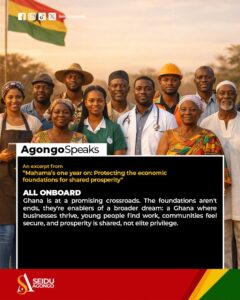
Indeed, Ghana is at a promising crossroads. The economic and governance foundations now being strengthened are not ends in themselves. They are enablers — tools meant to support a broader national dream: a Ghana where businesses can grow without unnecessary hurdles, where young people can find meaningful work, where communities feel secure, and where prosperity is not an elite privilege but a shared reality
. The task ahead is clear. All of us must join hands to guard the progress made, deepen the reforms, and translate stability into opportunity. Ghana has laid the right foundation. Now is the time to build boldly, inclusively, and with unwavering commitment to the wellbeing of every citizen.
Alhaji Seidu Agongo is a businessman and philanthropist
Source: www.thenewindependentonline.com