Political News Desk
Accra, Oct. 3, 2026 — Tensions are mounting within the National Democratic Congress (NDC) in the Bortianor-Ngleshie Amanfro Constituency (BNAC) as a dispute over the constituency’s delegate album, arising from allegations of irregularities in branch elections, moves from party offices to the courtroom.
At the centre of the dispute are questions over the accuracy of membership and delegate records, how complaints about the records were handled, and whether concerns raised by aggrieved members were adequately investigated before the party’s internal electoral process advanced.
The controversy has brought the roles of BNAC Constituency Chairman Atsu Modzaka and Greater Accra Regional Chairman Emmanuel Nii Ashie Moore into focus, although the allegations do not by themselves establish wrongdoing by either official.
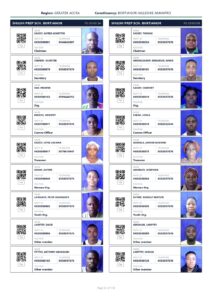
The dispute comes as the NDC prepares for its constituency-level executive elections scheduled for October 24 and 25, 2026. The party’s published timetable places the elections within a broader reorganisation process that includes branch-level registration, register authentication, validation of elected branch executives and subsequent constituency and regional elections. (NDC)
Petitions submitted, answers awaited
According to the aggrieved members, concerns over the constituency’s branch-election album were initially pursued through internal party channels.
A regional representative had undertaken an audit exercise, during which Nicholas Afedzi, who was representing some of the aggrieved members, was advised to formally document and submit the concerns.
A petition was subsequently submitted to the Constituency Secretary, Dan Bright Abbayatey.
The petition was acknowledged by the secretary with his signature, according to the complainants. However, they say that after nearly a month, they had received no substantive response addressing the issues raised.
The Constituency Organiser subsequently submitted another petition to the national party leadership, with a copy sent to the Greater Accra Regional Secretariat.
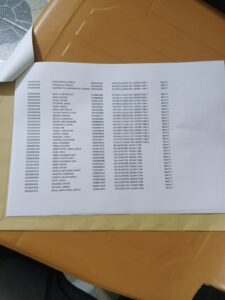
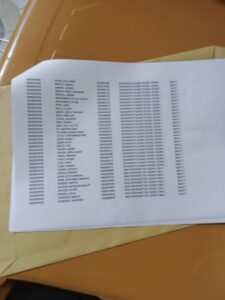

Again, the aggrieved members say that approximately another month passed without a substantive resolution.
A reminder was subsequently sent, but the absence of a satisfactory response eventually led the complainants to pursue legal action.
The sequence of petitions, acknowledgements and reminders has therefore become an important part of the dispute, raising questions about what action was taken after the complaints entered the party’s internal administrative system.
What members are challenging
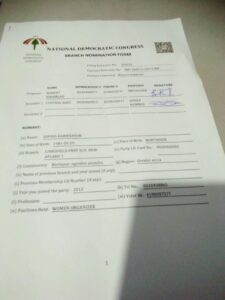
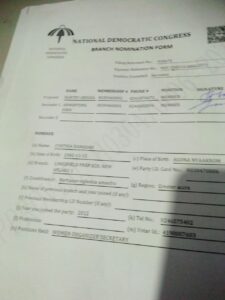
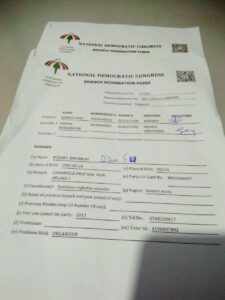
The central issue is the constituency’s disputed membership and delegate album.
Aggrieved members have alleged missing names, questionable membership records, transfers between branches, inconsistent personal information and photographs that allegedly do not correspond with the individuals listed.
A report published on October 2 cited claims that one telephone number was reportedly associated with 1,435 people in the disputed album. The same report said members alleged that about 305 people had been removed from the album, while others had allegedly been transferred to different branches. There were also claims involving photographs allegedly mismatched with the names attached to them. (Ghana News Online)
Those claims have not been independently verified.
The significance of the allegations, however, lies in the question they raise about the integrity of the records being used to determine who qualifies to participate in the internal electoral process.
The complainants are effectively asking whether the album accurately represents eligible party members in their respective branches and whether any discrepancies were properly investigated and corrected before the electoral process moved forward.
From party offices to the courtroom
The failure to resolve the complaints internally has now taken the matter beyond party offices.
Court processes were served on the Constituency Chairman and Secretary. According to the complainants, there were difficulties in effecting service, with the chairman eventually being served through a court bailiff.
The writ was subsequently amended to include the Electoral Commission and the National Democratic Congress.
The development marked a significant escalation of a dispute that had initially been pursued through petitions and internal party channels.
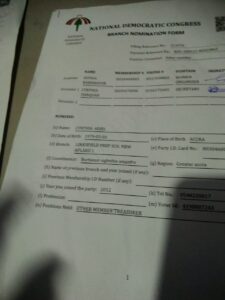

At a meeting of the Greater Accra Regional leadership, the constituency executives were also informed about an interlocutory injunction arising from the court proceedings, according to the account provided by the aggrieved members.
The precise scope and effect of any court order, however, must be determined from the actual court documents and orders rather than from descriptions by either side.
Why Modzaka and Ashie Moore are in focus
The dispute has placed both constituency and regional leadership under scrutiny because of their respective positions within the party’s structure.
As Constituency Chairman, Modzaka is part of the constituency-level leadership responsible for the administration of the branch and constituency structures.
Ashie Moore, as Greater Accra Regional Chairman, occupies the regional leadership position with oversight responsibilities within the region.
Publicly available reporting also identifies Ashie Moore as the Greater Accra Regional Chairman and records his involvement in the NDC’s 2026 branch-election process. (Ghana News Online)
That does not, however, establish that either official personally caused or participated in any alleged irregularity.
Rather, the documentary questions now facing the party concern what complaints were received, who was responsible for investigating them, what verification was undertaken and whether corrective action was considered before the next stage of the internal elections.
The paper trail
The emerging dispute makes the documentary trail particularly important.
Among the questions requiring answers are:
- When exactly were the complaints about the album first received?
- Who was assigned responsibility for investigating them?
- Was the disputed album independently audited?
- Were individual membership records checked against the party’s underlying registration data?
- Were allegations involving missing names, branch transfers and mismatched photographs investigated?
- What criteria were used to add, remove or transfer members?
- Were affected members given an opportunity to challenge disputed entries?
- What response did constituency leadership provide to the petitions?
- What action did the Regional Secretariat take after receiving copies of the complaints?
- Was the national party leadership formally asked to intervene?
- Were any corrections made to the album following the complaints?
The answers could help establish whether the dispute resulted from administrative errors, outdated information, data-management problems or other issues.
The allegations alone cannot establish deliberate manipulation or determine whether any individual benefited from the reported discrepancies. Those questions require documentary evidence and, where appropriate, findings from the party’s internal processes or the court.
NDC’s own electoral rules put records in focus
The dispute comes at a point when the NDC’s own published 2026 reorganisation framework places considerable emphasis on membership records and register verification.
The party’s official roadmap provides for the return of branch registers, membership registration and updates, register authentication and subsequent validation of elected branch executive data before the higher-level elections. (NDC)
The published guidance also states that members should have unhindered access to check branch registers for verification and correction, while provisions are included to prevent the transfer or swapping of membership numbers belonging to deceased members. (NDC)
These provisions make the accuracy of the branch registers more than an administrative issue. They form part of the foundation upon which participation in the party’s internal elections is organised.
The constituency elections are officially scheduled for October 24 and 25, followed by regional elections on November 14 and 15 and the national congress on December 19, 2026. (NDC)
A dispute with an earlier BNAC court history
The current dispute is not the first time internal NDC disagreements involving the Bortianor-Ngleshie Amanfro Constituency have reached the courts.
In 2018, two BNAC party members sued the NDC over aspects of the party’s rules for its presidential primary, leading to an interim injunction in December that year. The case was subsequently reported as contributing to a review of the disputed presidential-primary guidelines. (Graphic Online)
That earlier case is separate from the present dispute and does not establish any connection between the two matters.
It does, however, provide historical context for the extent to which disagreements over internal party procedures in the constituency have previously moved beyond party structures into the courts.
Petitioners reject personal motive
The aggrieved members maintain that their complaints are not directed at individuals for personal or political reasons.
Their stated concern is that the party’s internal electoral rules should be followed and that the membership records used to determine eligibility should be accurate, verifiable and capable of withstanding scrutiny.
They have therefore called for the relevant records and processes to be examined rather than relying solely on competing claims by individuals within the constituency.
The dispute is now before the judicial process, where the parties will have an opportunity to present their respective documents and arguments.
What happens next
The immediate question is no longer simply whether complaints were made.
It is whether the complaints generated a verifiable administrative response before the dispute escalated into litigation.
For the party leadership, the matter presents an opportunity to clarify the administrative trail: when the complaints were received, what investigations were undertaken, whether corrections were made and what procedures govern challenges to disputed membership records.
For the complainants, the court proceedings provide a formal avenue through which their claims can be tested.
For the constituency’s wider membership, the outcome could determine how disputed records are treated as the NDC proceeds with its 2026 internal elections.
The central issue remains the integrity and verifiability of the electoral records. The allegations concerning the BNAC album remain unproven unless established through documentary verification, party procedures or judicial findings.
As the October 24–25 constituency elections approach, attention is therefore likely to remain on the disputed album, the paper trail behind the petitions and the responses of the officials and institutions responsible for resolving the matter.
This version keeps the Modzaka–Ashie Moore focus, but makes the investigative core the paper trail, unanswered petitions, album verification and accountability process, rather than suggesting that either official has been found responsible for wrongdoing.
Source: www.thenewindependentonline.com