Ghana must move beyond exporting raw commodities and strengthen local industries to secure lasting economic prosperity amid intensifying global competition, economic experts have cautioned.
They made the call at the fifth edition of the Nyansa Dialogue, hosted by the Nyansa Institute for Strategic Dialogue in Accra on Friday, October 30, under the theme, “How does Ghana Protect its Economic Prosperity in an Age of Strategic Competition?”
The forum featured economist Emmanuel Amoah-Darkwah and policy strategist and researcher Marie-Noelle Nwokolo, who examined how Ghana could maximise the benefits of international trade, foreign investment and its natural resources.
In a speech read on his behalf, the Institute’s Executive Director and Founder, Samuel Koranteng Adjei, urged Ghana to engage global powers strategically and ensure international partnerships served its long-term national interests.

He said economic prosperity must translate into jobs, competitive local businesses, stronger industries, improved living standards and resilience to external shocks.
Trade Agreements Must Benefit Local Industries
Mr Amoah-Darkwah called for trade agreements that promote local production and enable Ghana to retain more value from its natural resources.
While acknowledging China’s introduction of tariff-free access for African goods effective May 2026, he urged Ghana to assess whether its trade arrangements were delivering favourable outcomes.
He noted that Ghana and several African countries continued to run trade deficits because they exported mainly raw materials while importing finished products.

He called for greater investment in domestic processing and value addition, citing bauxite and manganese as resources Ghana had mined for decades without adequately developing the industries needed to process them.
He also urged government to protect job-creating sectors such as pharmaceuticals, textiles, poultry and automobile manufacturing.
“It’s not enough to have a trade deal between China and Ghana. What are we exporting to China in terms of the value chain? Are they raw commodities or are they value-added?” he queried.
Stronger Institutions and Policy Continuity Needed
Ms Nwokolo identified weak institutional coordination, short-term political thinking and inadequate infrastructure as major barriers to Ghana’s economic transformation.
She said although the country had introduced several development policies and established institutions to address national challenges, poor implementation remained a persistent problem.
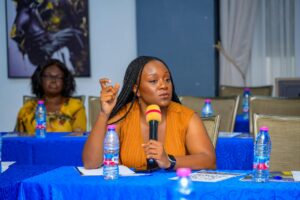
Citing unemployment, she pointed to overlapping mandates among state institutions and inadequate coordination, arguing that creating more institutions would achieve little without effective collaboration.
She also called for policy continuity, warning that changes in development priorities between successive governments undermined long-term planning.
She urged political parties and other stakeholders to agree on a common national development plan to guide successive governments over the next 20 to 50 years.
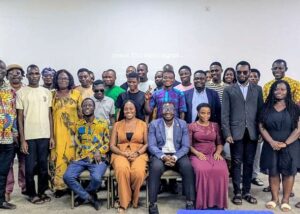
“There’s a lot that we have on paper. There’s a lot we’ve written. There’s a lot we’ve committed to. Ghana is one of those countries that, on paper, not a lot of people can match us,” she said.
Citizens Must Be at the Centre of Economic Policy
Ms Nwokolo further stressed that economic policies must address the everyday needs of Ghanaians, arguing that positive economic indicators meant little if they did not improve living conditions.
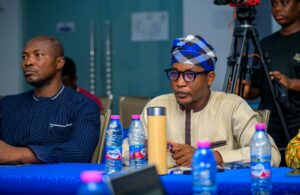
Drawing on Afrobarometer data, she identified healthcare and employment as key public concerns requiring urgent attention.
She, however, cautioned against treating every development challenge as an immediate priority, urging policymakers to make deliberate choices and properly sequence interventions.
Investment in Data Critical for Mineral Negotiations
Mr Amoah-Darkwah also urged Ghana to invest in geological exploration and data gathering to strengthen its bargaining position in negotiations over critical minerals.
He noted that demand for the minerals was rising as countries accelerated their transition to cleaner energy, but stressed that Ghana needed reliable information about its mineral resources to negotiate investment agreements from a position of strength.
The Nyansa Dialogue is part of the Institute’s efforts to provide a platform for policymakers, researchers, business leaders and citizens to examine issues shaping Ghana’s development.
Source: www.thenewindependentonline.com